
Customer Success - The Secret Engine of GTM

In the current market landscape, a "shiny tech stack" is no longer a competitive advantage; it’s the baseline for successful GTM motion.
As we navigate 2026, the companies winning the market share battle aren't just selling more effectively; they are operating more cohesively.
Following the "Decoding GTM in 2026" workshop at The Customer Conference (TCC) in London (with Sandy Yu, a leading certified GTM Partner), we defined GTM as a transformational process for accelerating your path to market with high-performing revenue teams delivering a connected customer experience. We also zoomed in on why modern GTM strategies are failing.
And when GTM breaks, it usually happens due to three specific "leak" points:
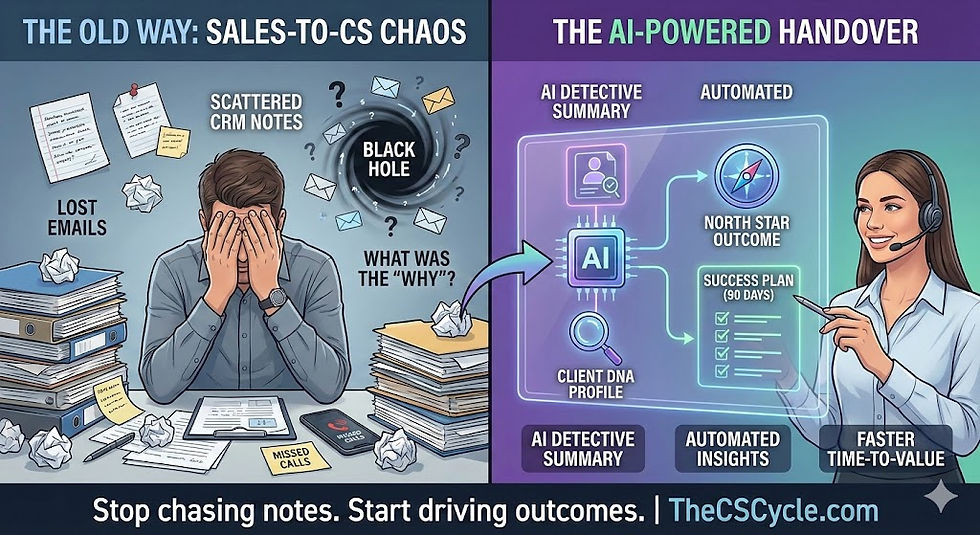
The Handoff Leak: Information silos and uncoordinated transitions between departments.
The Value Leak: The disconnect between a vendor’s perceived value and the customer’s actual outcomes.
The Silent Leak: The unexpected churn resulting from missed sentiment, behavioral signals, and a lack of stakeholder engagement.
Reflecting on the aftermath of the workshop, it’s clear to me that Customer Success is the core, and often hidden, contributor to a streamlined GTM strategy.
It is the "glue" that connects the moving parts, bridging gaps and mitigating revenue leaks.
Here is how high-performing CS teams resolve the seven most critical GTM challenges. It should be considered as initial guidelines for a proactive and courageous CS who can make a significant impact in their organization.
1. Moving Beyond "Sales Heroics."
The "Sales Maverick" who closes massive deals through overpromising creates an immediate deficit for the organization. This "heroism" often leads to early-stage friction with customers, internal “blame games”, and ultimately leads to churn.
The CS X Factor: A mature CS framework provides Sales with a repeatable, structured, and proven success blueprint. When CS consistently delivers high retention, Sales teams can sell with confidence rather than "winging it," knowing the post-sale infrastructure is a safety net, not a black hole. The Sales-To-CS will become a consistent motion rather than a one-off success.
2. Closing the Synchronization Gap
Marketing builds the dream, Sales sells the vision, but CS inherits the reality. If these three pillars are out of sync, customer trust erodes during onboarding.
The CS X Factor: CS mirrors reality, acting as the field agent, looping "on-the-ground" feedback back to Marketing and Sales. CS ensures the brand promise aligns with the product's capabilities, bridging the gap between expectations and the outcomes customers achieve.
3. Eliminating "Forecast Fog."
A GTM engine is flying blind if it cannot predict revenue for the next two quarters. Without a clear view of the current customer base and commercial opportunities, it is impossible to justify the future investment required for future growth.
The CS X Factor: By maintaining the CRM as a single source of truth, CS and sales replace "gut feelings" with engagement-backed data. With the client’s requirements and sentiment in mind, CS provides an accurate assessment, supporting a reliable sales forecast. In this regard, CS drives a proactive business plan that targets specific clients in a timely manner and with the right context.
4. Solving the ROI Mystery
In 2026, "nice-to-have" vendors are the first to be cut.
With AI tools promising rapid automation, being "liked" by your customers is no longer a retention strategy.
The CS X Factor: CS must document specific, measurable outcomes early in the lifecycle. By driving customers to acknowledge tangible ROI, CS safeguards the account against competitors and against yet-to-be-proven internal AI pilots.
5. Protecting Market Share
Losing market share is rarely a failure of the product alone; it is a holistic GTM failure to keep up with the market.
The CS X Factor: Proactive CS teams serve as the organization's "early warning system."
By identifying shifting client needs and challenges, then feeding those insights to Product and Marketing, CS turns existing wins into Customer Advocacy. Moreover, CS can equip Sales with the winning stories and references needed to fend off new market entrants.
6. Securing Early Entry into Deal Cycles
Entering a deal cycle late is a defensive battle. The goal is to be the "preferred vendor" before the RFP is even written.
The CS X Factor: A reputation for hassle-free renewals and high-impact delivery creates a "halo effect." Through warm references and industry word of mouth, a strong CS presence helps Sales bypass traditional competitors and secure a leading position early in the evaluation process.
7. Navigating the Upmarket Shift
Moving from SMB to Enterprise requires more than just a higher price tag; it requires a complete overhaul of the service delivery model.
The CS X Factor: CS leads the transition to Enterprise-grade delivery by reassessing onboarding, adoption, and governance. By aligning with Product to meet the rigorous requirements of a regulated, demanding client base, CS gives the rest of the GTM team the confidence to engage and sell in high-end markets.
The Bottom Line: Human-Centric GTM
In 2026, Go-To-Market is no longer a linear handoff; it is a continuous, circular transition. Success requires a "human-in-the-loop" approach where Customer Success balances the velocity of technology with the stability of human partnership.
If your GTM engine feels unstable, don't just look at your lead generation or sales volume. Look at the glue that connects all the important pieces. It is the CS team that should be empowered to bridge these gaps. If not, that is exactly where you should start.


Comments